
At a glance
How replica watches compare in mechanical timekeeping and visual detail, what timegrapher readings show, and why high similarity is not authenticity.
Replica-watch accuracy has two meanings: timekeeping accuracy and visual accuracy. A well-regulated mechanical replica may keep useful daily time, while another example with the same movement may gain or lose much more because of assembly, position, magnetism, or service condition. Visually, high-tier replicas can be close at normal distance but still differ in dial, crystal, case, bracelet, and movement details.
No responsible retailer should promise “perfect 1:1 accuracy.” The useful approach is to define which kind of accuracy matters, identify the exact reference and movement, and judge the allocated watch rather than a factory label alone.
Timekeeping accuracy is measured, not photographed
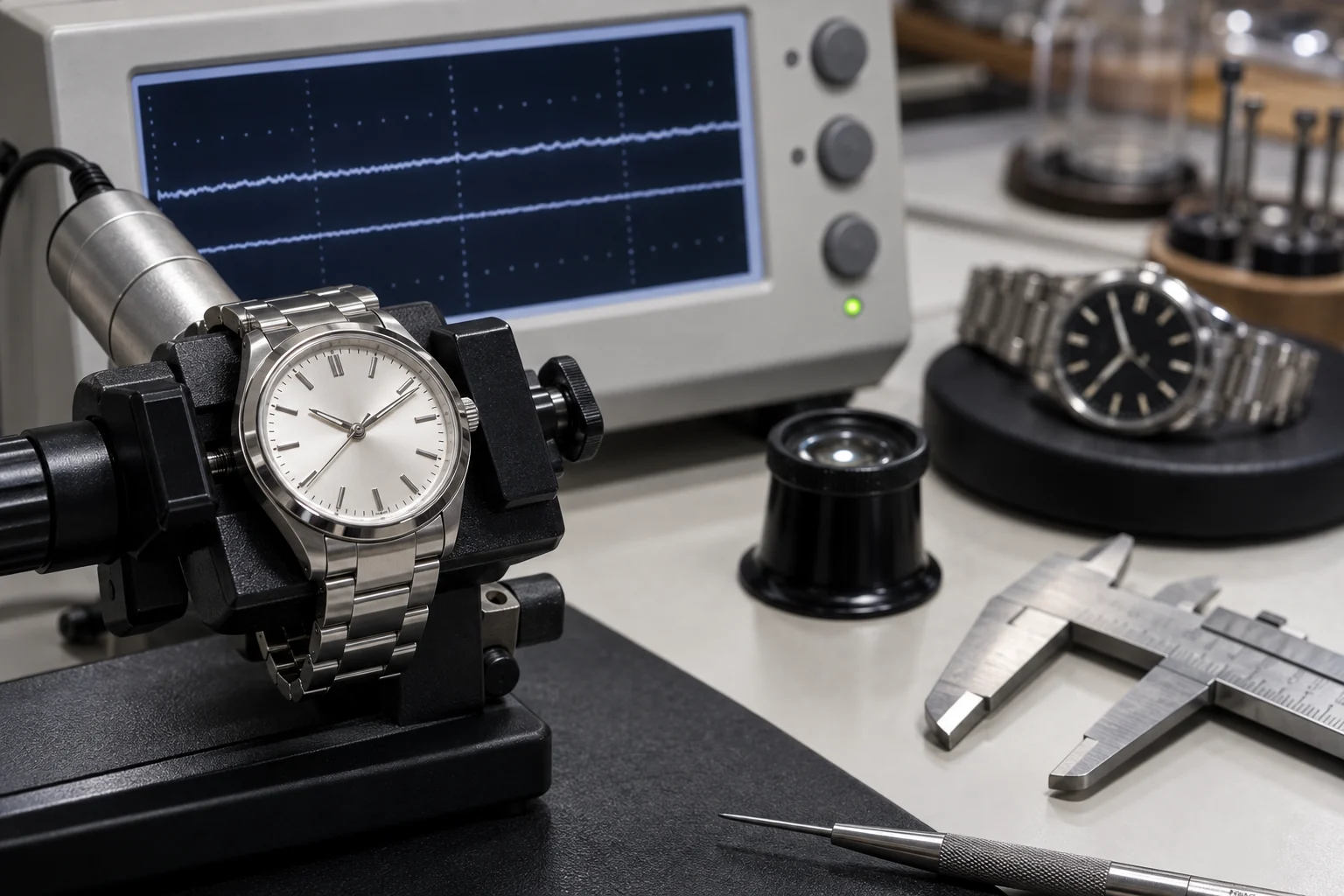
Mechanical watches are affected by position, winding level, temperature, shock, lubrication, and magnetic fields. A timegrapher can show rate, amplitude, and beat error in one or more positions, but it is a snapshot under controlled conditions. Wrist results also depend on how the owner wears and rests the watch.
| Signal | What it describes | What it cannot prove alone |
|---|---|---|
| Rate | Estimated seconds gained or lost per day in that position | Long-term performance in every position |
| Amplitude | Balance swing under the test conditions | Overall health without context |
| Beat error | Timing symmetry of the balance impulses | Future reliability |
| Power-reserve test | How long the watch runs from a defined wind | Accuracy throughout the full reserve |
A readable timegrapher image is useful during QC, but the movement name and test conditions should be known. Regulation can improve rate when the movement is otherwise healthy; it cannot repair worn or damaged components.
Quartz and mechanical replicas differ
Quartz modules are usually more precise in daily timekeeping and need less positional analysis. Mechanical replicas offer the movement behavior many enthusiasts want, but they require more tolerance for variation and maintenance. A complex clone chronograph or GMT may reproduce functions while adding components that need correct adjustment.
What visual accuracy includes
- Case diameter, thickness, lugs, crown guards, and profile.
- Dial color, printing, markers, hands, date window, and luminous material.
- Crystal height, edge, anti-reflective appearance, and magnification.
- Bezel font, insert color, action, and alignment.
- Bracelet width, taper, end links, clasp, finish, and articulation.
- Movement layout, crown sequence, hand stack, and visible decoration.
A watch can be strong in one area and weak in another. One version may have a convincing dial but an incorrect case profile. Another may have better dimensions but a movement that operates differently from the genuine reference.
Why photos can mislead
Lighting changes dial tone, ceramic color, polished edges, and crystal reflections. Macro lenses exaggerate small dust and alignment differences, while shallow angles can hide the rehaut, bezel, or date window. Retouched catalog images may not show the current batch.
Private QC should include a straight-on view, both case sides, clasp and bracelet, case back, relevant functions, and timing information where available. Our QC checklist provides a consistent order.
Can experts still identify a high-tier replica?
Yes. Experienced watchmakers and authenticators use details that casual viewing may miss: finishing geometry, printing, metal surfaces, crystal behavior, movement architecture, component tolerances, serial conventions, and provenance. Some differences appear only after opening the case or comparing against a verified genuine example.
A replica should never be purchased on the promise that it will pass authentication. Accuracy of appearance is not authenticity.
How accurate should a buyer expect it to be?
Expect the specifications and QC agreed for the particular replica—not the original brand’s published chronometer, depth, material, or warranty standard. Ask the seller to separate design claims from measured results. For example, a copied dial rating is not a pressure test, and an advertised power reserve is not a test of the allocated watch.
If precise daily time is essential, compare the actual movement, request timing evidence, and plan for local regulation. A phone or quartz watch will usually be the more practical time standard.
How to improve mechanical timekeeping
Keep the movement adequately wound, avoid strong magnets and repeated shocks, note performance over several days, and test different resting positions. If the rate changes suddenly or varies widely, ask an independent watchmaker to diagnose before regulation.
Serviceability matters. Our replica service guide explains how movement type affects repair options.
Our merchant answer
High-tier replicas can be visually convincing and mechanically usable, but “perfect” is not a measurable product grade. We identify the supplied configuration, show the allocated watch, provide available timing evidence, and explain remaining uncertainty. Customers who require factory-certified accuracy, provenance, and official support should buy a genuine watch.
Frequently asked questions
How many seconds per day should a replica lose?
There is no category-wide number. The exact movement, condition, position, and regulation decide the result. Judge a specific test and real wear.
Does a clone movement keep better time?
Not automatically. Clone architecture may improve functional similarity, while regulation and condition determine timekeeping.
Can a timegrapher guarantee accuracy?
No. It provides useful measurements under stated conditions, not a permanent guarantee across every position and state of wind.
Can a replica be visually identical?
It can be close in selected details, but materials, finishing, tolerances, movement construction, and provenance still provide ways to distinguish it.
Disclosure: VSFHQ.com is an independent replica-watch retailer and information resource. Products discussed are replicas and are not manufactured, sponsored, authorized, or warranted by the original brands referenced for design identification.
We separate listed specifications from observations that must be confirmed on the current production batch. Movement functions, dimensions, and configuration details are cross-checked against the product catalog; QC recommendations identify what a buyer should verify on the allocated watch.