
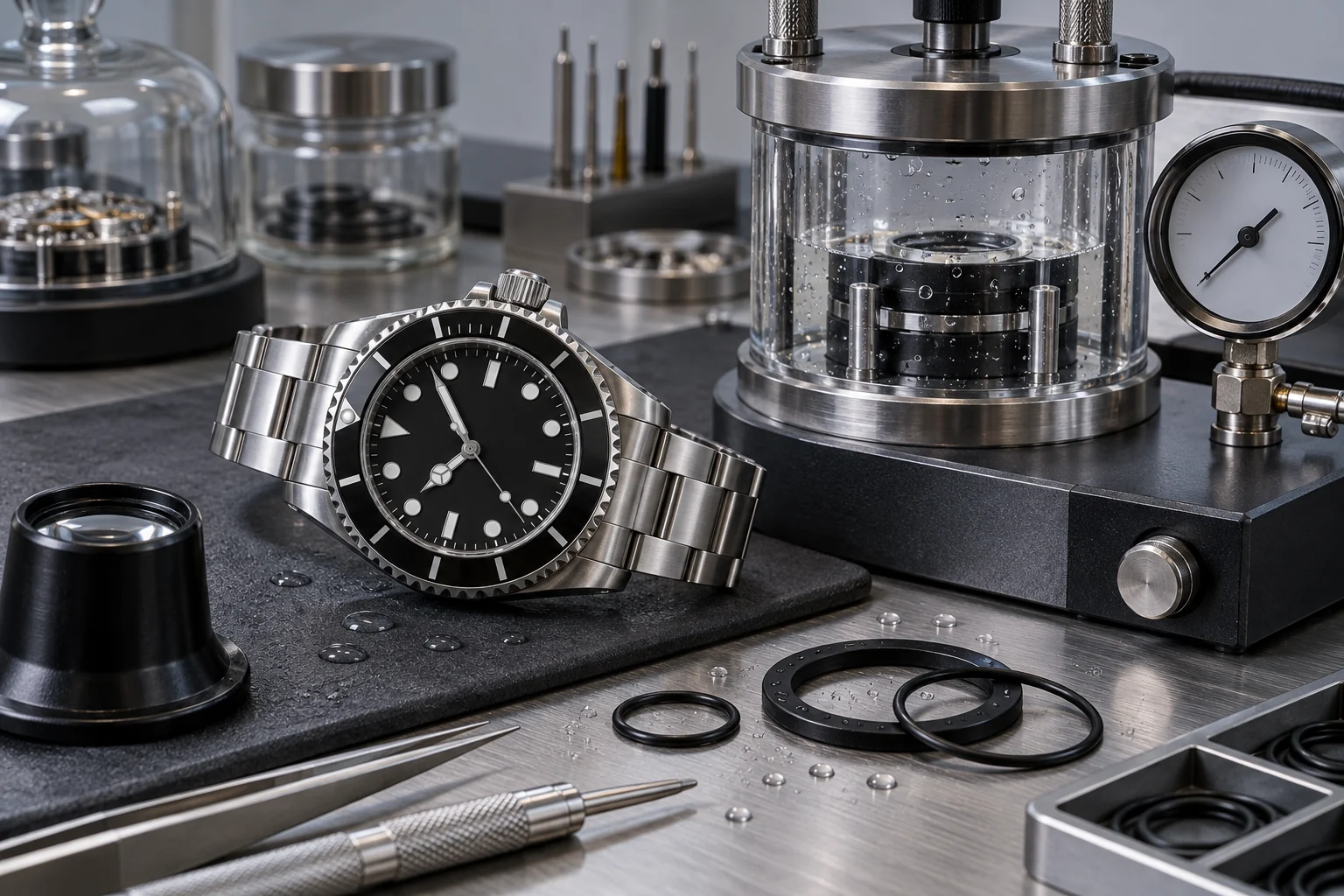
At a glance
Why copied depth ratings are not proof, how professional pressure testing works, where leaks occur and when swimming with a replica is realistic.
A replica watch can be water-resistant after the individual watch passes an appropriate professional pressure test, but it should not be assumed waterproof from the number printed on its dial or case back. Seals, crown threads, crystal fit, case-back fit, assembly, age, impact, and temperature all affect the result.
We avoid the word “waterproof” because no mechanical watch remains permanently sealed under every condition. For a replica, uncertainty is higher because production and testing are not backed by the original brand’s standards or warranty.
Printed depth ratings are not test results
A dive-style replica may copy “100 m,” “300 m,” or another rating from the genuine reference. That marking describes the design being imitated; it does not prove that the delivered watch was tested to the same protocol. Even two watches from the same batch can seal differently.
The only useful evidence is a current test on the actual watch, performed with equipment and a protocol appropriate to the intended use.
Where water can enter
- Crown and crown-tube threads.
- Case-back gasket and seating surface.
- Crystal gasket or retaining system.
- Chronograph pushers, helium-style valves, or other openings.
- Damaged case surfaces, corrosion, or a hard impact.
A gasket can be present and still fail because it is dry, pinched, the wrong size, dirty, or compressed unevenly. Tightening the case back harder is not a substitute for correct inspection.
What pressure testing can tell you
| Test approach | What it helps assess | Limitation |
|---|---|---|
| Dry pressure test | Case deformation or leakage without immersing the watch | Equipment and interpretation matter |
| Wet test using an empty case | Locates bubbles and leak paths | The movement should not be exposed |
| Condensation check | May reveal moisture already inside | Not a substitute for a rated test |
| Visual gasket inspection | Finds obvious damage or contamination | Cannot prove pressure performance |
Ask the watchmaker what pressure was used, whether positive and negative pressure were tested, and what activities the result reasonably supports. “Passed” without context is incomplete.
Can you swim with a replica watch?
Only consider swimming after a recent professional test on that watch, and follow the watchmaker’s advice. Keep the crown fully closed, do not operate pushers underwater unless the construction and test specifically support it, and avoid jumping or high-impact water activities that create pressure spikes.
If the watch has not been tested, treat it as unsuitable for swimming. Removing it is cheaper than repairing corrosion throughout a movement.
Why hot showers and steam are risky
Heat changes air pressure and can affect seals. Soap reduces surface tension and helps water move through small gaps. Steam and condensation can reach places that ordinary splashes do not. A watch that survives a quick rinse may still develop moisture in a hot shower or sauna.
Our practical advice is to remove the watch before showering, bathing, or entering a sauna, even after a positive pressure test.
How long does a pressure test remain valid?
There is no permanent validity. A test describes the watch at that moment. Impacts, crown use, aging seals, temperature changes, and opening the case can alter performance. Test again after service, crystal or crown work, a hard impact, or before a period of regular swimming.
What to do if moisture appears
Stop wearing and operating the watch. Do not pull the crown repeatedly, press chronograph pushers, or attempt to dry it with high heat. Bring it to a watchmaker promptly so the case can be opened, the source assessed, and the movement protected from corrosion.
Fogging under the crystal is not normal and should not be ignored because it later disappears.
How water resistance affects buying decisions
If water use is important, tell the seller before choosing the watch. Simpler cases with sound crown construction may be easier to assess than watches with multiple pushers or decorative valves. Still, the model category does not guarantee the individual result.
Private QC should check crown operation and visible case condition, but QC photos cannot prove a seal. Use the pre-shipment QC checklist for what images can establish, then arrange local testing for water exposure.
Our merchant policy
We do not promise permanent waterproofing or rely on copied depth markings. Where a test is represented, the test details should be stated. The safest assumption before independent verification is that the watch is splash-sensitive.
Frequently asked questions
Is a screw-down crown enough?
No. It helps compress a sealing system, but the tube, gaskets, crystal, and case back must also be sound.
Can I wash my hands with an untested replica?
Avoid direct water and submersion. Accidental light splash is different from a verified rating, so dry the watch promptly.
Does a dive-style replica have better resistance?
Its design may be more suitable, but only the individual assembled watch and current test provide evidence.
Can service restore water resistance?
A watchmaker can inspect surfaces, replace seals, close the case correctly, and retest. Damage or poor tolerances may still limit the result.
Disclosure: VSFHQ.com is an independent replica-watch retailer and information resource. Products discussed are replicas and are not manufactured, sponsored, authorized, or warranted by the original brands referenced for design identification.
We separate listed specifications from observations that must be confirmed on the current production batch. Movement functions, dimensions, and configuration details are cross-checked against the product catalog; QC recommendations identify what a buyer should verify on the allocated watch.