
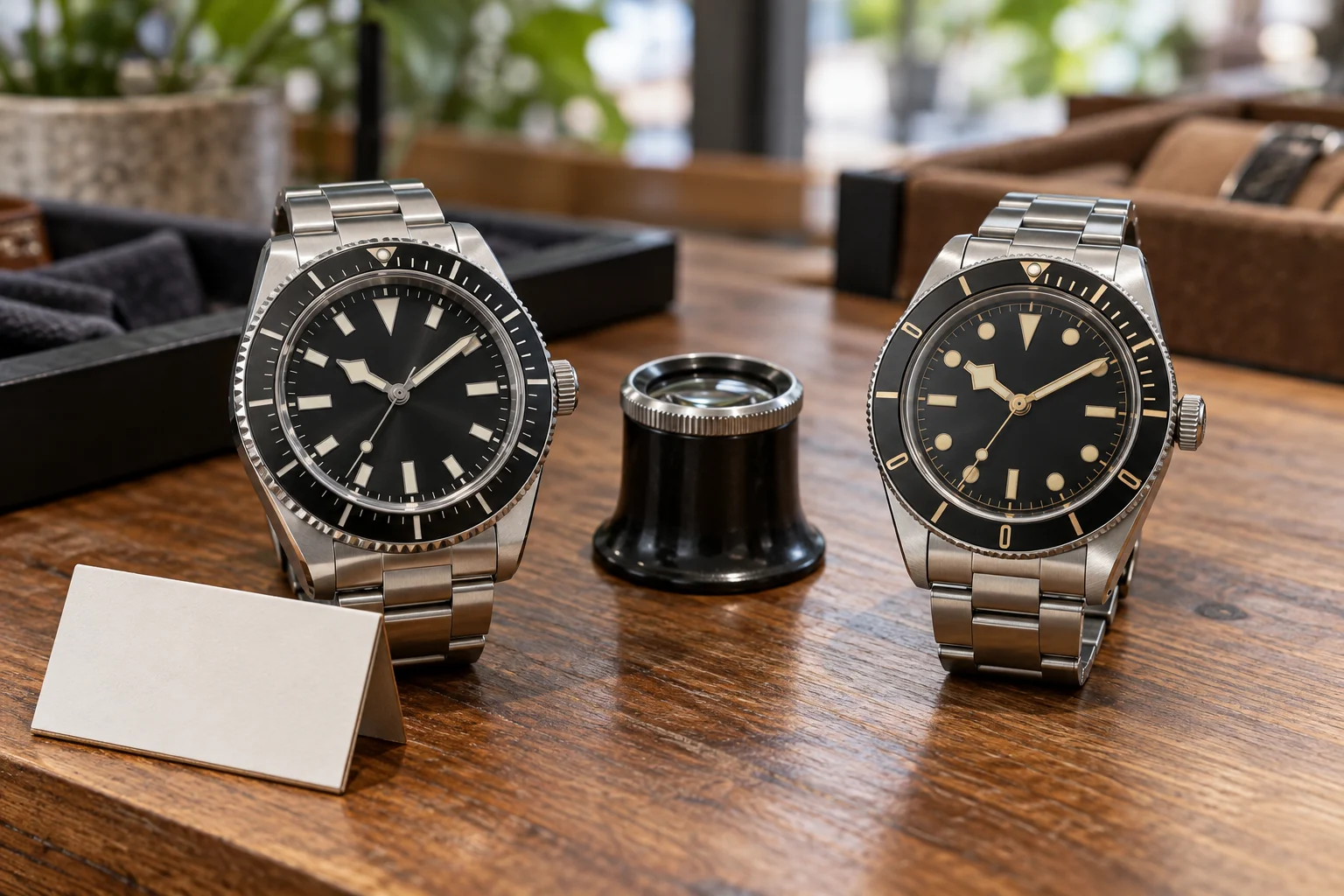
At a glance
A practical comparison of homage and replica watches covering branding, design, service, value, resale and which option fits different buyers.
An homage watch borrows recognizable design ideas while using its own brand; a replica watch tries to reproduce another branded watch and commonly carries copied marks. That difference affects what the product claims to be, how it can be sold, the legal risk, and the kind of value a buyer receives.
We sell disclosed replicas, but an honest merchant should still explain when an homage may be the better purchase. A customer who mainly wants a dive-watch shape, fluted-bezel dress style, or integrated-bracelet look may not need copied branding at all.
Side-by-side comparison
| Question | Homage watch | Replica watch |
|---|---|---|
| Brand on the dial | The homage maker’s own brand | Often copied original-brand marks |
| Design approach | Inspired by a style or familiar elements | Aims to reproduce a specific reference |
| Authenticity claim | A genuine product from the homage maker | Not a genuine product from the copied brand |
| Warranty | May include the homage maker’s warranty | Only the independent seller’s stated remedy |
| Service route | Often uses a standard documented movement | May use specialized or decorated clone movements |
| Resale and platforms | Usually easier when accurately described | Often restricted by platform and trademark rules |
What makes a watch an homage?
An homage may use familiar proportions, bezel styles, dial layouts, handset shapes, or bracelet architecture, but it presents itself under its own name. Good homages also change enough details to have a coherent identity rather than merely deleting a logo.
Because the watch is sold as the homage maker’s product, specifications, warranty, and service can be discussed directly. Quality still varies, and design rights can still be complicated, but the buyer is not being asked to treat an unauthorized branded imitation as the original.
What makes a watch a replica?
A replica normally targets a particular reference and tries to reproduce its branding and visual details. Higher-tier examples may copy the case dimensions, dial, crystal, bezel, bracelet, clasp, crown operation, movement layout, serial patterns, and packaging.
Closer similarity does not create authenticity. The original brand did not make or authorize the watch, and its warranty does not apply. Our replica versus counterfeit guide explains why copied marks are the key issue.
Why choose an homage?
- You like the overall design but do not need the original name.
- You want a clearer warranty and parts route.
- You prefer a product that can be discussed and resold under its real maker.
- You are uncomfortable with copied trademarks or customs risk.
- You want a common movement that local watchmakers recognize.
An homage can also offer its own colors, sizes, materials, or specifications instead of following a single reference exactly.
Why choose a replica?
A replica buyer usually wants reference-specific appearance: the original-style dial, bezel, bracelet, case shape, and sometimes movement behavior. The interest may be visual comparison, collecting factory versions, or wearing a specific design at a lower purchase price.
The buyer accepts important compromises: no authentic provenance, no original-brand service, uncertain resale, possible customs exposure, and reliance on independent QC and repair. Those tradeoffs should be understood before the product is recommended.
Which offers better value?
Value depends on the goal. An homage can be better long-term value when it includes a standard movement, documented warranty, and accessible parts. A replica can feel more satisfying to a buyer focused on a particular reference’s external details. Price alone does not settle the question.
Compare the full ownership cost: purchase, shipping, pressure testing, regulation, service, and the possibility that a specialized movement cannot be repaired locally. Our replica value guide helps make that decision.
How to identify misleading listings
A seller may call a copied-brand watch an homage to avoid the word replica, or call an unbranded homage a “legal replica.” Ignore the label and inspect the product. Which name and logo appear? Is the listing claiming original provenance? Is the maker clear? Are copied cards or serials being used to suggest authenticity?
Conversely, a legitimate homage should not be described as a genuine watch from the design it references. It is authentic only as a product of its own maker.
Our recommendation process
We ask whether the customer values the exact branded appearance or simply likes the style. If the brand identity is not important, an homage often removes unnecessary complications. If reference-specific reproduction is the goal, we explain that the replica remains unauthorized and should never be presented as genuine.
Frequently asked questions
Is an homage a fake watch?
Not when it clearly uses its own brand and is sold as its maker’s product. Similar design does not by itself mean the watch claims to be the original.
Can an homage look almost identical?
Some are very close in overall layout. The branding and the product’s claimed source remain important distinctions.
Do homage watches hold value?
Most are consumer products rather than investments, but resale is usually more straightforward because they can be identified by their real maker.
Which is easier to service?
Homages often use common movements, while high-detail replicas may use specialized clones. The exact caliber matters more than the category name.
Disclosure: VSFHQ.com is an independent replica-watch retailer and information resource. Products discussed as replicas are not manufactured, sponsored, authorized, or warranted by the original brands referenced for design identification.
We separate listed specifications from observations that must be confirmed on the current production batch. Movement functions, dimensions, and configuration details are cross-checked against the product catalog; QC recommendations identify what a buyer should verify on the allocated watch.