
At a glance
A realistic lifespan guide covering movements, lubrication, shocks, water exposure, warning signs, service access, and habits that help a super clone last.
A good mechanical super clone can remain usable for several years, and sometimes longer, but there is no honest fixed lifespan. Its life depends on the movement, assembly, lubrication, water exposure, shocks, wearing habits, and whether an independent watchmaker can service it. A high price or convincing appearance does not guarantee long-term mechanical reliability.
We tell customers to think in terms of maintenance and risk rather than a countdown. One watch may run well for years with modest care. Another may need regulation, a seal replacement, or movement work much earlier. QC reduces the chance of receiving an obvious problem, but it cannot predict every future failure.
What determines the lifespan?
The movement
Simple, established automatic movements may be familiar to more watchmakers and easier to replace. Reference-specific clone movements can provide more accurate crown functions, dimensions, or appearance, but parts and expertise may be more specialized. Ask not only how closely a movement copies the original, but also how it will be maintained where you live.
Assembly and lubrication
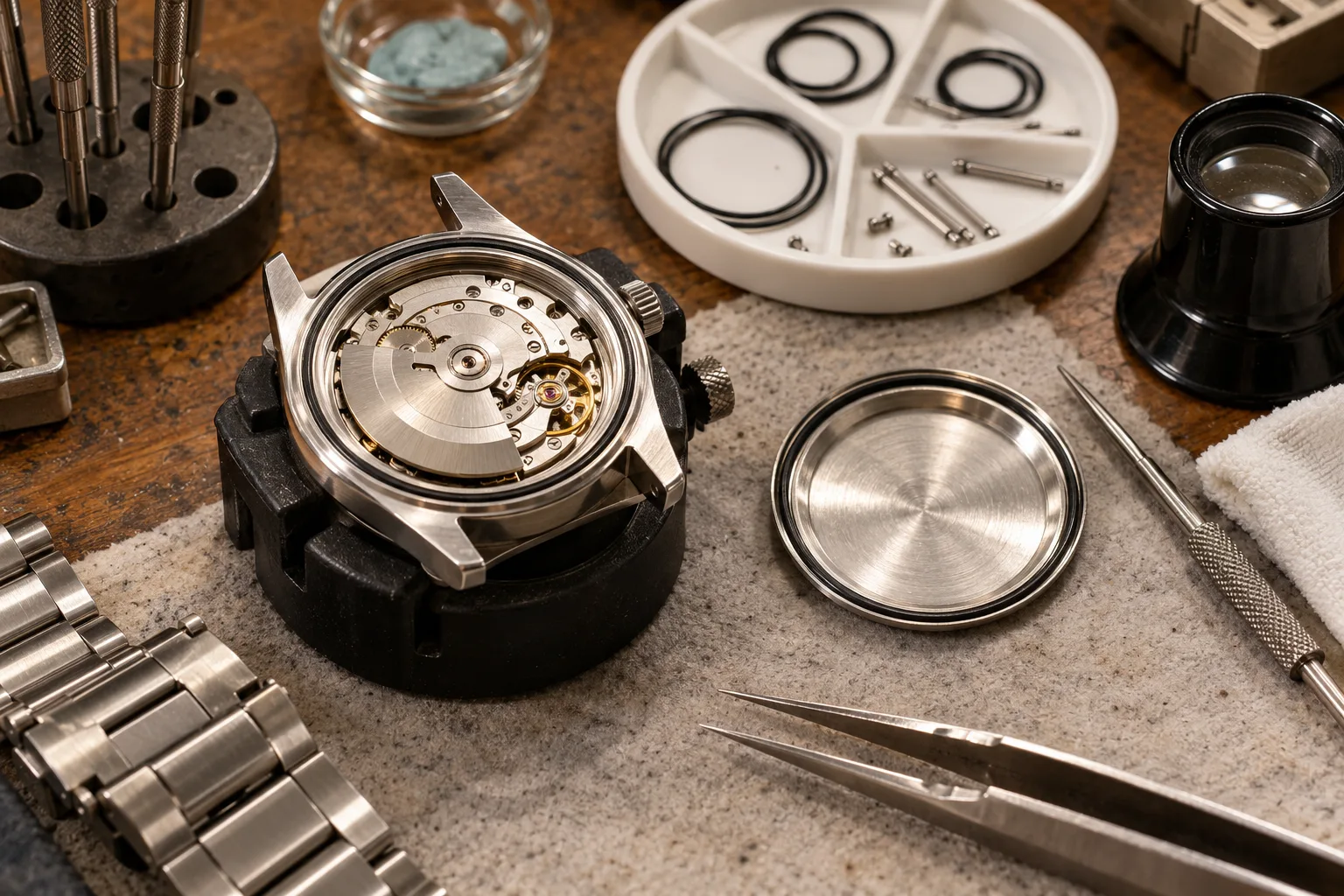
Two watches carrying the same movement label can leave assembly in different condition. Oil quantity, cleanliness, screw security, hand clearance, rotor operation, and regulation all matter. A timegrapher reading helps identify an obvious current issue, but it does not show every internal surface or guarantee future performance.
Water, shock, and magnetism
Moisture can damage a mechanical watch quickly. Never infer water resistance from a diver-style case or screw-down crown. Pressure testing is required for the individual piece, and seals deteriorate with time. Drops, golf swings, tools, loud speakers, magnetic clasps, and strong electronics can also affect operation or accuracy.
How the owner handles it
Forcing the crown, cross-threading it, changing the date when the mechanism is engaged, overwinding a manual-wind watch, or operating a chronograph incorrectly can create avoidable damage. The correct procedure depends on the movement. If the seller cannot explain the controls, pause before experimenting.
| Habit | Why it matters | Better practice |
|---|---|---|
| Wearing it in showers or pools | Heat, pressure, soap, and aging seals can admit moisture | Keep it dry unless the individual watch passes a current pressure test |
| Forcing a resistant crown | Can damage stem, keyless works, or threads | Stop and have the cause inspected |
| Changing date near midnight | Can conflict with the engaged date-change mechanism | Move the hands away from the changeover period first |
| Waiting for complete failure | Wear or contamination may spread damage | Investigate new noise, poor reserve, or large timing changes early |
What QC can tell you before shipping
QC should confirm the correct model, visible condition, crown and function operation, and a readable timing snapshot. It may catch a watch that does not run, has a severe beat error, shows abnormal amplitude for the test conditions, or has an obvious functional problem. It also lets the buyer reject the wrong reference or unacceptable cosmetic condition before international shipping.
QC cannot simulate years of wear. A short video cannot prove lubrication quality, water resistance, long-term power reserve, or every internal component. Treat it as an admission check, not a warranty forecast. Our QC checklist separates what can be inspected from what remains uncertain.
Warning signs that need attention
- The watch stops despite normal winding and wear.
- Power reserve becomes much shorter than its established normal behavior.
- Timekeeping changes suddenly rather than gradually.
- The rotor becomes unusually loud, rough, or immobile.
- The crown grinds, slips, or will not engage a setting position.
- The date or GMT function begins sticking or changing at an abnormal time.
- Condensation appears under the crystal.
If moisture is visible, stop wearing and operating the watch and contact a watchmaker promptly. Repeatedly winding or heating the case can make matters worse.
When should a super clone be serviced?
There is no universal interval because movements, use, and starting condition differ. A watch that is running stably does not always need immediate full service, while a watch showing symptoms should not wait for a calendar date. Some buyers choose an early inspection and lubrication check; others monitor performance and service when accuracy, reserve, or feel changes.
Before buying, find out whether a local independent watchmaker accepts replica watches and the specific movement family. Be honest about what the watch is. Surprising a watchmaker with a replica damages trust and may result in refused work.
Repair, replace, or upgrade the movement?
The answer depends on parts, labor, and sentimental value. A simple movement may be economical to replace. A clone movement may justify targeted repair if parts and expertise are available. In some cases, the cost of extensive work approaches the value of the watch. Ask for a diagnosis and estimate before authorizing service.
Never assume an original movement will fit or that genuine-brand components are appropriate. Dimensions, dial feet, hand sizes, date alignment, case clamps, stems, and crown systems can differ even when the exterior looks similar.
How to help the watch last
- Keep it dry unless it has passed a recent professional pressure test.
- Wind and set it gently; never force resistance.
- Learn the safe date-setting procedure for its movement.
- Avoid drops, strong magnets, and high-vibration activities.
- Rinse no replica under a tap based only on a listing claim.
- Have new symptoms checked before they become a complete failure.
- Use an independent watchmaker who understands the movement.
Our practical expectation
We sell super clones as mechanical replicas, not maintenance-free appliances. A correctly supplied, carefully handled watch can provide years of enjoyment, but the owner must accept more uncertainty than with a genuine watch supported by its manufacturer. Budget for local testing and eventual service, and choose the movement with serviceability in mind.
For the VSF-specific version of this question, see how long VSF watches last. That guide also explains daily rate, power reserve, and long-term care without promising a lifespan we cannot verify.
Frequently asked questions
Can a super clone last ten years?
It is possible for a maintained mechanical replica to remain usable that long, but it is not a responsible guarantee. Service history, movement, parts, and use determine the result.
Should I service a new super clone immediately?
Not automatically. Consider an independent inspection if the watch shows symptoms or if you want a baseline check. Opening the case should include proper resealing and, where needed, pressure testing.
Does a clone movement last longer than a standard movement?
Not by definition. Clone architecture may improve reference accuracy, while a common standard movement may be easier to repair. Condition and maintenance matter more than the label alone.
Does winding the watch every day damage it?
Normal, gentle operation should not. Forcing the crown, using the wrong procedure, or continuing when the mechanism feels abnormal can cause damage.
Disclosure: VSFFactory.us is an independent replica-watch retailer and information resource. Products discussed are replicas and are not manufactured, sponsored, authorized, or warranted by the original brands referenced for design identification.
We separate listed specifications from observations that must be confirmed on the current production batch. Movement functions, dimensions, and configuration details are cross-checked against the product catalog; QC recommendations identify what a buyer should verify on the allocated watch.