
At a glance
A clear explanation of replica, counterfeit and homage watches, how quality tiers and movements differ, and what responsible buyers and retailers should disclose.
Replica watches are watches made to imitate the design, branding, and often the reference details of watches produced by another company. A replica that carries copied trademarks is not an authentic product from the original brand, regardless of how closely it resembles one or how a seller grades it. “Clone,” “super clone,” “1:1,” and “mirror quality” are market descriptions, not authenticity.
Our store sells disclosed replica watches. We use original brand and model names to identify the design reference being compared, but we do not claim sponsorship, authorization, or original-brand warranty. That distinction should be clear before a customer pays.
Replica, counterfeit, homage, and fake: what is the difference?
People use these words loosely, but the branding matters. A watch that copies protected brand names, logos, and model marks is generally a counterfeit-marked replica. An homage may borrow broad design cues while using its own brand and avoiding copied marks. “Fake” is common buyer language for any non-genuine product, while “replica” is the term sellers often use to describe the category.
| Type | Branding | What the buyer receives |
|---|---|---|
| Genuine original | Authorized brand marks | Original provenance, manufacturer support, and applicable warranty |
| Replica / counterfeit-marked watch | Copied brand and model marks | An unauthorized imitation with no original-brand warranty |
| Homage | The maker’s own brand | A legally separate product inspired by a style |
| Custom or modified genuine watch | Original base with changed parts | Authenticity and warranty depend on the base and modification |
How replica-watch quality levels differ
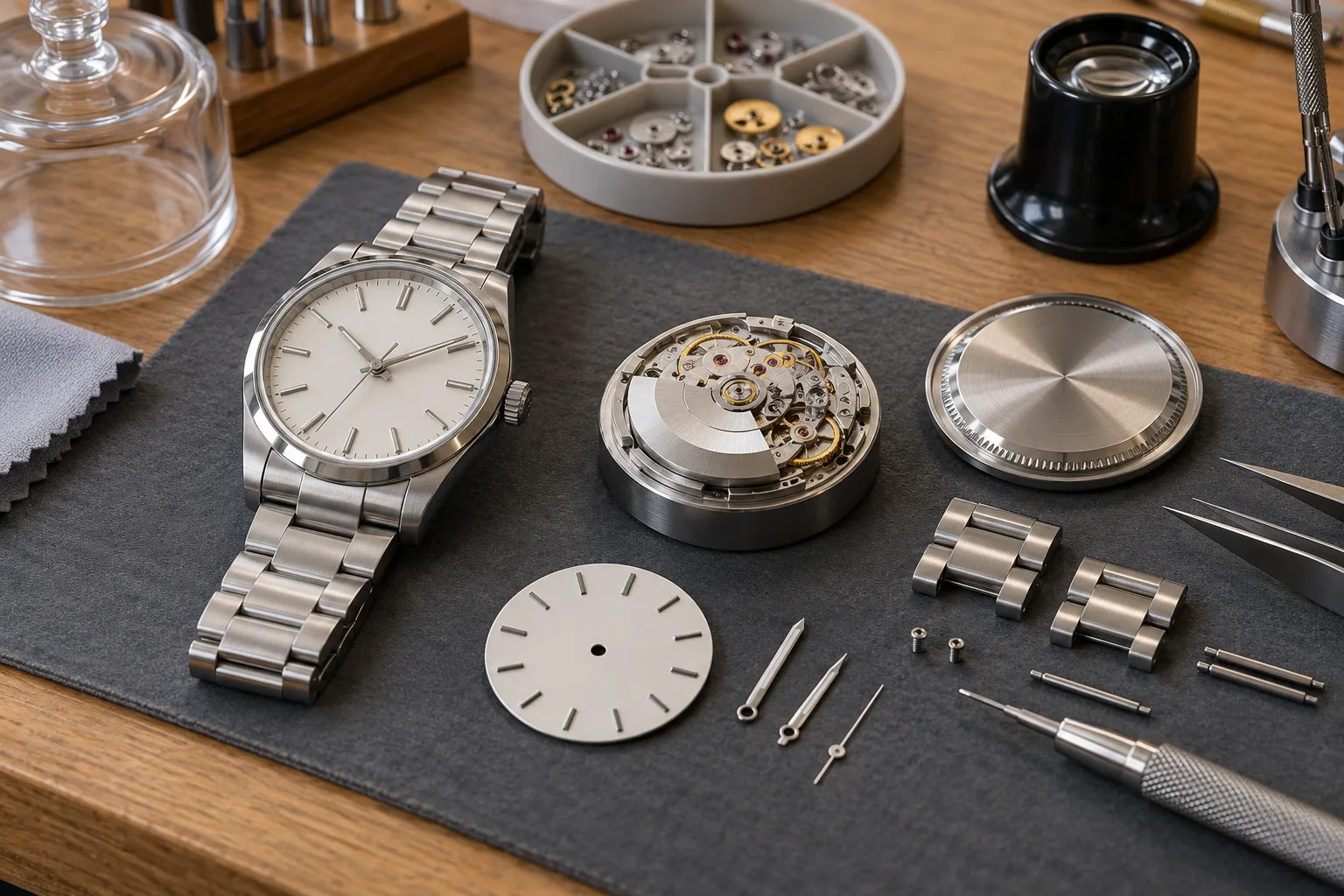
Entry-level replicas may use approximate case shapes, printed dials, mineral crystals, folded or light bracelets, plating, and generic movements. Mid-tier pieces may improve the crystal, case finish, dial, and bracelet while retaining a common movement. Higher-detail or “super clone” versions usually aim for reference-specific dimensions, materials, exterior parts, and movement functions.
There is no independent grading authority. One seller’s “AAA” may be another seller’s basic version. The buyer needs the exact reference, movement, materials, functions, dimensions, and current QC.
What is inside a replica watch?
The movement can range from a simple quartz module to a common automatic caliber or a complex clone movement designed around the layout and controls of the original. Decoration visible through a case back does not prove the movement architecture. Ask how the crown operates, how complications work, and whether parts and independent service are available.
A movement name in a title is only a claim until it agrees with the supplied watch. For common 3235-style options, see our movement comparison.
Why do people buy replicas?
Customers give different reasons: they like the design but not the original price; they want to try a size or style before considering a genuine watch; they enjoy comparing mechanical details; or they want a lower-cost object for casual wear. Those motivations do not turn the product into an original or remove legal and ethical concerns.
A replica should never be used to deceive a buyer, lender, insurer, authenticator, or resale platform. If a customer intends to present it as genuine, we do not support that use.
How close can a replica look?
High-tier examples can reproduce the broad appearance and many reference details closely. Differences may remain in dial tone, font, luminous material, crystal optics, bezel feel, case contours, finishing, bracelet tolerances, weight distribution, and movement construction. Experienced watchmakers and authenticators may identify those differences.
Photography can hide or exaggerate them. Studio lighting and retouching may make polished surfaces and dial colors look unlike the watch in hand. Private QC under neutral lighting is more useful than a single hero photograph.
Are replica watches reliable?
Some run for years, while others need early regulation or repair. Reliability depends on the movement, assembly, lubrication, owner handling, water exposure, and service access. The absence of original-brand quality control and warranty creates more uncertainty.
Do not assume water resistance from a copied depth rating. The individual watch needs professional pressure testing, and seals require maintenance. Read our service-life guide for realistic mechanical expectations.
How a responsible retailer should sell them
- State clearly that the product is a replica.
- Identify the reference and supplied configuration.
- Separate supplier claims from features that need current QC.
- Use a consistent payment and order trail.
- Show the allocated watch before dispatch.
- Publish shipping and after-sale terms.
- Never offer original-brand authentication or warranty.
Our normal sequence is order confirmation, allocation, private QC, customer approval, dispatch, and tracking. The QC checklist explains what the customer should inspect.
Legal and ethical considerations
Trademark and customs rules vary by country and activity. Importing, selling, and distributing counterfeit-marked goods can carry materially different risks from simple possession. Customs authorities may detain or seize a shipment. A retailer’s shipping policy cannot make an inadmissible product legal.
Ethically, a buyer should understand that the product copies another company’s protected design and marks. Clear disclosure prevents one type of harm—consumer deception—but it does not create authorization from the brand. Anyone uncomfortable with that should choose a legitimate homage or an original watch.
How to decide if a replica fits your goal
Ask whether you are comfortable with the product’s identity, legal risk, lack of original warranty, uncertain resale, and independent-service requirement. Then compare a specific reference and seller. If provenance, collector value, brand service, and guaranteed authenticity matter, a replica is the wrong product.
Frequently asked questions
Are replica watches the same as fake watches?
In common usage, yes when they copy branding and design without authorization. “Replica” does not make the watch genuine.
Are all look-alike watches illegal counterfeits?
No. A legitimate homage can use its own brand and avoid copied protected marks. Legal analysis depends on the actual product and jurisdiction.
Can a replica be authenticated as genuine?
No. An expert may identify its source or version, but that is different from authenticating it as an original-brand watch.
Do replicas come with a manufacturer warranty?
They do not come with warranty from the original brand. Any commercial warranty or remedy is offered only by the independent seller under its own terms.
Disclosure: VSFFactory.us is an independent replica-watch retailer and information resource. Products discussed are replicas and are not manufactured, sponsored, authorized, or warranted by the original brands referenced for design identification.
We separate listed specifications from observations that must be confirmed on the current production batch. Movement functions, dimensions, and configuration details are cross-checked against the product catalog; QC recommendations identify what a buyer should verify on the allocated watch.