
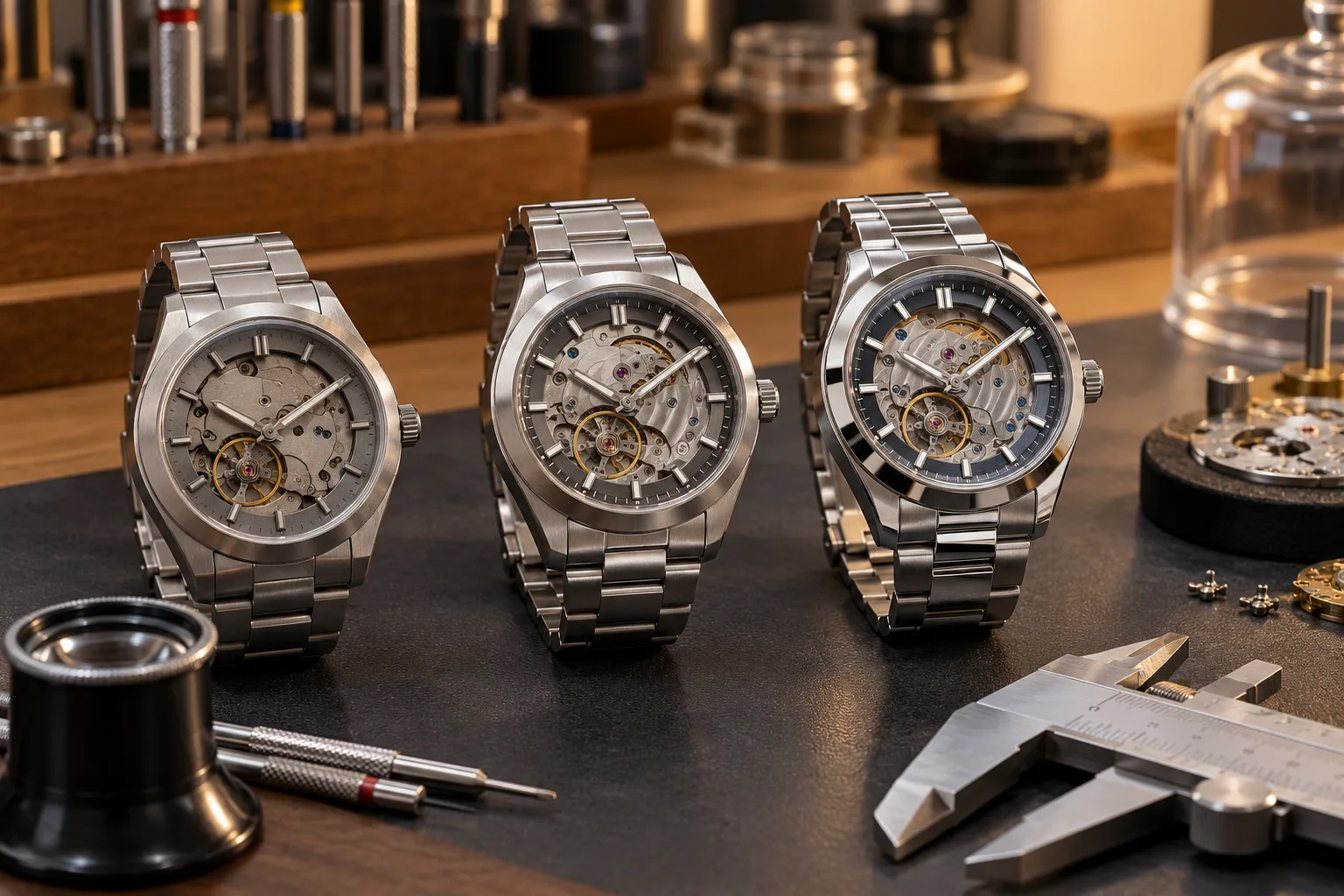
At a glance
Why AAA, 1:1, Swiss grade and super clone are not universal standards—and the five reference, movement, exterior and QC factors that provide a real comparison.
There is no universal “best grade” for replica watches. Labels such as A, AAA, 5A, 1:1, Swiss grade, and super clone are created by sellers and do not follow a shared inspection standard. The best practical grade is the version whose exact reference, movement, materials, construction, and QC match your priorities.
We use market terms such as super clone because buyers recognize them, but we do not ask customers to pay based on a grade alone. A detailed specification can be checked; “AAA+” cannot. If two sellers use different labels for the same configuration, the letters are not a meaningful comparison.
Why replica grades are inconsistent
The replica market has no independent body defining tolerances or testing watches before a grade is assigned. Sellers may invent tiers to organize their catalog, translate a wholesaler’s description, or make one option sound exclusive. The same term can describe an inexpensive generic watch on one site and a reference-specific clone movement on another.
Grades can also remain in a product title after the underlying parts change. A new batch may use a different movement, dial, or bracelet while retaining the same marketing label. Current details matter more than the inherited name.
| Common label | What sellers often intend | Why it is insufficient |
|---|---|---|
| A / AAA / 5A | A relative quality tier within that seller’s range | No shared definition or test |
| 1:1 | Close exterior resemblance | Does not prove identical materials or dimensions |
| Swiss grade | Premium positioning or a claimed movement origin | Often used without verifiable origin evidence |
| Super clone | Higher-detail, reference-specific replica | Still seller-defined and model-dependent |
Five factors that create a useful quality comparison
1. Correct reference and dimensions
The watch should be built around a specific reference, not a generic case carrying a similar dial. Compare diameter, thickness, lug shape, crown guards, case back, and bracelet fit. A visually attractive watch with the wrong proportions may be a poor choice for a detail-focused buyer.
2. Dial, hands, bezel, and crystal
Check layout, marker construction, hand length, printing, date position, dial texture, bezel insert and action, crystal profile, and magnification where applicable. Color needs neutral light because studio processing can distort it.
3. Movement and functions
Identify the caliber family and demonstrate the controls. A GMT should show which hour hand adjusts independently. A chronograph should start, stop, and reset. A no-date watch should not be graded highly merely because the dial hides an unused date position. Decoration alone is not architecture.
4. Bracelet and clasp
Bracelet taper, link construction, articulation, screw condition, end-link fit, brushing, polished surfaces, clasp security, and adjustment features strongly affect daily use. This is often where a cheap watch feels cheap even when the dial looks convincing.
5. Individual QC and serviceability
A strong version can still produce a weak unit. Check the allocated watch, not only the factory reputation. Also ask whether an independent watchmaker can service the movement and whether replacement parts are realistic to obtain.
Entry, mid-tier, and high-tier in practical terms
An entry-level replica prioritizes low price and broad appearance. A mid-tier watch usually improves materials and exterior execution while using a common movement. A high-tier watch aims for more reference-specific parts and movement behavior. These are useful descriptions only when they are followed by the actual specification.
A mid-tier watch can be the better purchase for someone who wants a robust, familiar movement. A high-tier clone movement can be the better purchase for someone who cares about correct thickness, crown sequence, or display-caseback appearance. “Higher” is not automatically better for every owner.
Does a Swiss movement make the highest grade?
Not automatically, and the claim requires evidence. Many replica movements are made or assembled in Asia, including sophisticated clone calibers. A genuine Swiss movement inside a replica case might improve service familiarity but may produce incorrect dimensions or functions for the reference. Origin alone does not grade the complete watch.
Ask for the exact caliber, not just the word Swiss. Then evaluate the movement’s condition, function, fit, and service path.
How we explain versions to a customer
We compare the reference, movement, dimensions, exterior parts, functions, current availability, and price. We state which details are supplier specifications and which must be confirmed in QC. If a customer asks for the “best grade,” we ask what compromise they are trying to avoid.
For 3235-style movements, our comparison guide shows why several high-tier labels can still differ mechanically. For the broader watch, the QC checklist turns quality claims into visible checks.
Questions to ask before paying a premium
- What exact reference and batch is this?
- Which movement is installed and how does it operate?
- What are the measured case dimensions?
- Which material claims are supplier specifications?
- What improves over the cheaper version?
- Will I receive private QC of the allocated unit?
- Who can service the movement later?
If the only answer is “this is our highest grade,” the premium is not yet explained.
Our direct recommendation
Ignore the number of A’s. Choose the exact reference and decide whether visual accuracy, functional accuracy, serviceability, or price matters most. Compare evidence at the model level and reserve final judgment for QC. That method works even when sellers use completely different grading language.
Frequently asked questions
Is AAA the best replica grade?
No. AAA has no universal definition. It may be a seller’s top tier or ordinary marketing language.
Is a super clone higher quality than 1:1?
The terms overlap and remain seller-defined. Compare the exact parts, movement, dimensions, and QC rather than the words.
Does the highest grade look identical to genuine?
No responsible seller should promise that. Differences remain in provenance, warranty, movement construction, finishing, materials, and often visible details.
Can QC confirm the grade?
QC can confirm the supplied configuration, condition, and demonstrated functions. It cannot turn a marketing grade into independent certification.
Disclosure: VSFFactory.us is an independent replica-watch retailer and information resource. Products discussed are replicas and are not manufactured, sponsored, authorized, or warranted by the original brands referenced for design identification.
We separate listed specifications from observations that must be confirmed on the current production batch. Movement functions, dimensions, and configuration details are cross-checked against the product catalog; QC recommendations identify what a buyer should verify on the allocated watch.