
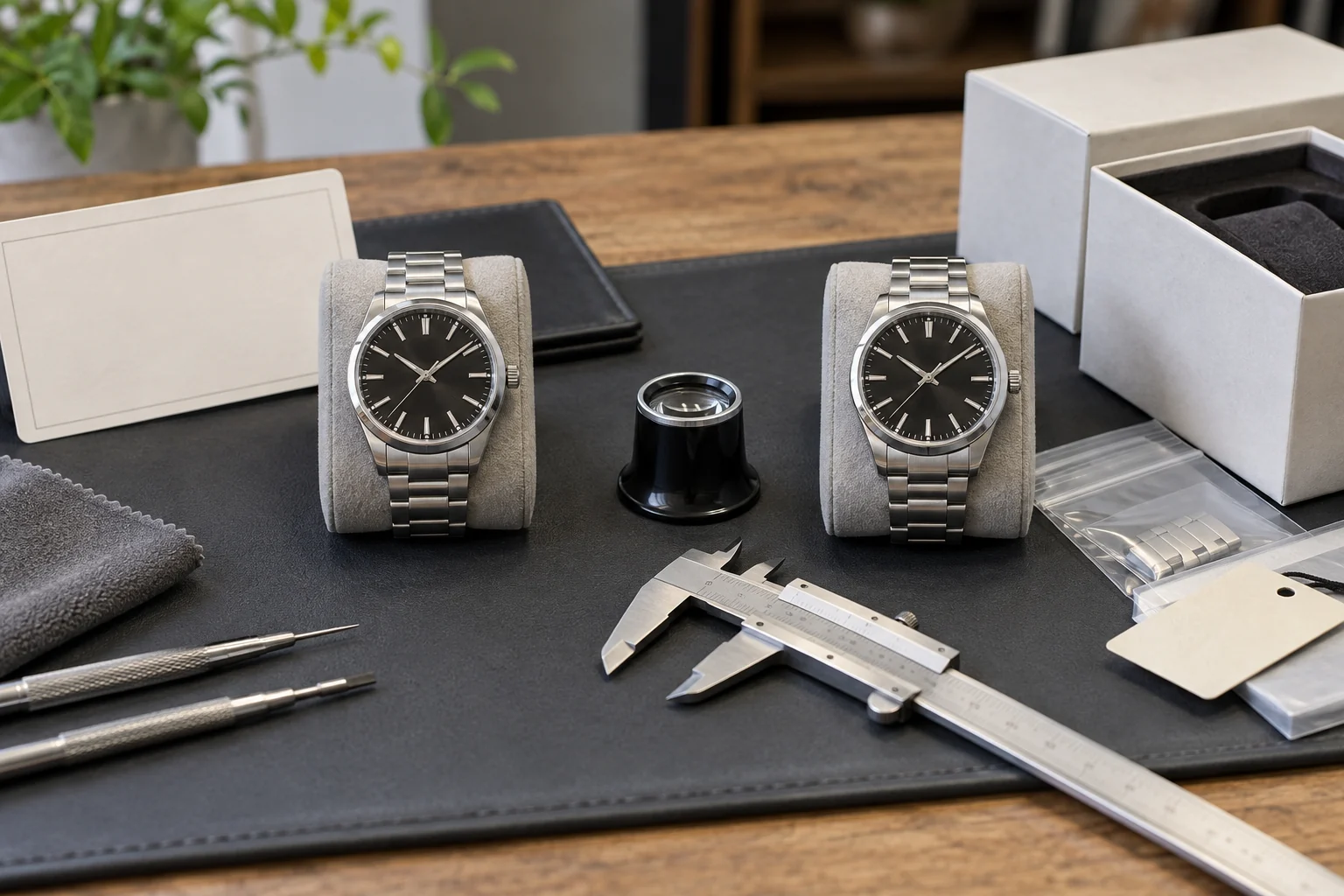
At a glance
How replica, counterfeit, homage and genuine watches differ—and why quality, serial numbers and seller wording do not change authenticity.
In ordinary watch-market use, a replica that copies another brand’s protected name, logo, and model identity is generally a counterfeit-marked product. Sellers often prefer the word “replica” because it describes imitation quality or appearance, while customs authorities and trademark owners focus on whether protected marks are used without authorization. Calling a watch a replica does not make it authentic or officially licensed.
We sell disclosed replica watches and believe the distinction must be stated plainly. The customer should know who made the product, what it is copying, and which warranty actually applies. A product can be carefully made and openly described while still being unauthorized by the original brand.
Why people use two different words
“Replica” is a commercial description. It can refer to anything from a loose visual imitation to a high-detail watch that copies branding, reference features, packaging, and movement decoration. “Counterfeit” is the legal and enforcement term commonly used when a product bears an unauthorized mark that is identical or confusingly similar to a protected trademark.
The words therefore overlap. A copied-brand replica may be marketed as a replica and treated as a counterfeit by a platform, payment provider, customs authority, or court. The seller’s vocabulary does not control the legal classification.
Branding is the clearest dividing line
| Product type | Name on the dial | What it claims to be |
|---|---|---|
| Genuine watch | The original brand | A product made or authorized by that brand |
| Copied-brand replica | Unauthorized original-brand marks | An imitation of a specific branded watch |
| Homage | The maker’s own brand | A separate product inspired by a design style |
| Custom genuine watch | Original base, sometimes altered parts | A modified original whose warranty and value require disclosure |
A watch without copied branding can still create design or trade-dress questions, but it is not the same situation as printing another company’s name on the dial. Buyers comparing an homage and a replica can read our separate homage guide.
Quality does not change authenticity
A low-cost imitation and a high-detail “super clone” may differ dramatically in crystal, case, bracelet, movement, and finishing. Neither becomes a genuine watch because it is better made. A serial number, copied warranty card, box, sticker, or matching reference also does not create provenance.
This matters in sales conversations. “Indistinguishable,” “passes authentication,” and “original except for the price” are misleading claims. The responsible description is that the product is a replica, with the original brand mentioned only to identify the design being copied.
Why the distinction matters to a buyer
- The original brand does not provide warranty or service.
- Customs may detain or seize a copied-brand shipment.
- Marketplaces and payment providers may prohibit the transaction.
- Insurance, lending, and authentication documents cannot treat it as genuine.
- Reselling it as an original can harm another buyer and create serious liability.
A retailer’s disclosure reduces the risk of deceiving the immediate customer, but it does not create authorization from the trademark owner or bind customs authorities.
What an honest listing should disclose
The listing should say that the watch is a replica, identify the reference used for design comparison, state the supplied movement and materials, and make clear that no original-brand warranty or authentication is included. It should also separate photographed features from claims that require confirmation during private QC.
Our replica-watch definition guide explains the category in more detail, including grades, movements, reliability, and buyer responsibilities.
Can a buyer call it a replica in resale?
Disclosure does not necessarily make resale permitted. Laws and platform rules vary, and many services prohibit counterfeit-marked goods even when the seller admits what they are. Never remove, alter, or invent provenance to get around a marketplace rule. If the watch changes hands privately, the recipient still needs complete disclosure and should not be encouraged to pass it onward as genuine.
Our merchant position
We use “replica” to describe the product category, not to soften its identity. The watches are not made, sponsored, authorized, or warranted by the original brands. Customers who want authentic provenance, official service, recognized resale, or the cleanest trademark position should choose a genuine watch or a legitimate homage.
Frequently asked questions
Is every replica watch counterfeit?
A watch that copies protected branding without authorization is generally treated as counterfeit-marked. A scale model or unbranded reproduction in another context may be described differently, so the actual marks and product matter.
Does “1:1 replica” mean authentic?
No. It is a marketing claim about similarity, not provenance or authorization.
Can a counterfeit watch be high quality?
It can have good materials or finishing, but manufacturing quality does not make it genuine or authorized.
Is a fake watch the same thing?
“Fake” is common consumer language for a non-genuine product. The exact legal description depends on the marks, conduct, and jurisdiction.
Disclosure: VSFHQ.com is an independent replica-watch retailer and information resource. Products discussed are replicas and are not manufactured, sponsored, authorized, or warranted by the original brands referenced for design identification. This article provides general information, not legal advice.
We separate listed specifications from observations that must be confirmed on the current production batch. Movement functions, dimensions, and configuration details are cross-checked against the product catalog; QC recommendations identify what a buyer should verify on the allocated watch.